News

Latest Newsletter

Accounting for the Birds We Don’t Recover

As quail season progresses, many quail camps across Texas find themselves hosting a steady stream of guests. With that comes an understandable focus on harvest numbers—how many birds are taken, how many coveys are encountered, and whether harvest remains within sustainable limits. In many camps, harvest efficiency is relatively low, often averaging less than one bird per covey rise. Under those circumstances, staying at or below the commonly recommended threshold of removing no more than 10% of the fall population can appear straightforward.

Latest Podcast

Episode 82: How Hunting Inspires Conservation

| Podcasts | No Comments
Join Dr. Dale and Dr. Ryan O'Shaughnessy in February as they visit with special guest Britt Hosmer Longoria. Britt is a private pilot, published writer, photographer, hunter and co-founder of the Longoria-Hosmer Foundation. The Foundation is focused on sustainable-use conservation, wilderness protection and community-based solutions in biodiverse regions. Her work…
LateWinter GreenUp: The Quiet Fuel Behind Spring Bobwhite Production
LateWinter GreenUp: The Quiet Fuel Behind Spring Bobwhite ProductionArticlesResearch

LateWinter GreenUp: The Quiet Fuel Behind Spring Bobwhite Production

Late Winter Nutrition for Quail Late winter on the Rolling Plains can look like a nutritional dead zone—dry grasses, bare ground, and a landscape that feels stuck between seasons. Then a timely February rain hits, and almost overnight, cool-season forbs and grasses green up. Depending on your country, that may…
Dr. Dan FoleyDr. Dan FoleyMarch 3, 2026
Cold Is Not the Enemy: What Winter Storm Fern Means for Bobwhite Survival
Cold Is Not the Enemy: What Winter Storm Fern Means for Bobwhite SurvivalArticlesResearch

Cold Is Not the Enemy: What Winter Storm Fern Means for Bobwhite Survival

By Dr. Dan Foley Over 4–5 days towards the end of January, Winter Storm Fern moved through Texas and much of the South with a familiar suite of stressors: hard freezes, wind, sleet/freezing rain, and intermittent snow. A winter-storm disaster proclamation was issued on January 22, 2026, and expanded to…
Dr. Dan FoleyDr. Dan FoleyJanuary 29, 2026
Keds, Eyeworms and Cecal Worms, oh my!
Keds, Eyeworms and Cecal Worms, oh my!ArticlesResearch

Keds, Eyeworms and Cecal Worms, oh my!

by Dr. Dan Foley Every hunter who cleans birds long enough eventually encounters something unexpected. During our recent fall trapping event on the Rolling Plains Quail Research Ranch (RPQRR), we observed several individual bobwhite quail carrying flat-looking flies moving through the feathers. These insects are louse flies—often called keds. Their…
Rolling PlainsRolling PlainsJanuary 5, 2026
Fall 2025 Quail Trapping Update
Fall 2025 Quail Trapping UpdateArticlesResearch

Fall 2025 Quail Trapping Update

by Mitchell Riggs We concluded our fall trapping efforts on December 20. We extend our sincere thanks to the many volunteers from Tarleton State University, West Texas A&M University, Texas Tech, Texas Parks and Wildlife Department, Rolling Plains Bobwhite Brigades, Texas Master Naturalists, and local landowners and managers who made…
Rolling PlainsRolling PlainsJanuary 5, 2026
How Nesting Cover Shapes Quail Success at the Research Ranch
How Nesting Cover Shapes Quail Success at the Research RanchArticlesResearchUncategorized

How Nesting Cover Shapes Quail Success at the Research Ranch

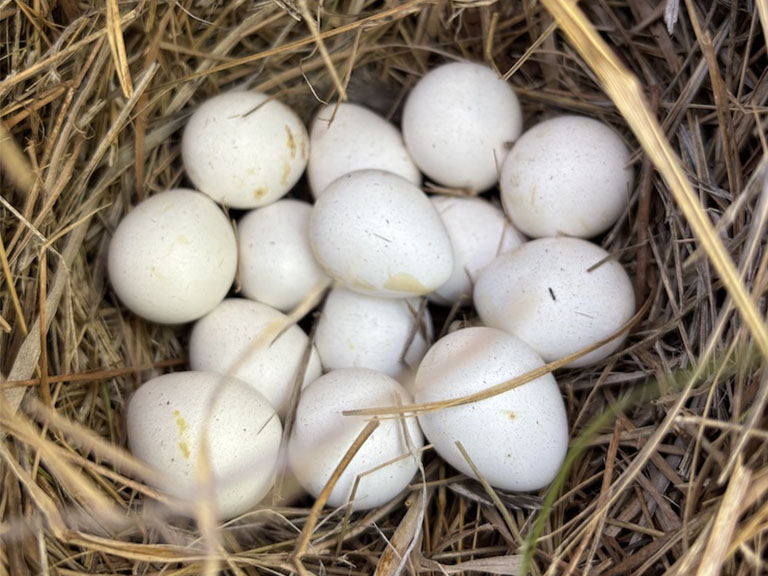
By Kyndal Underwood Successful nesting is one of the most important—and most vulnerable—stages in a quail’s life cycle. At the Rolling Plains Quail Research Ranch (RPQRR), technicians have spent more than a decade tracking where quail chose to nest and how these choices influence nest survival. A recent long-term study…
Rolling PlainsRolling PlainsJanuary 5, 2026
From Our Facebook Page
From Our Facebook PageArticles

From Our Facebook Page

by Dana Wright Every year we have people send us pictures of quail breasts with these spots on them wanting to know what they are, they are commonly referred to as "rice breast". The spots are lesions caused by parasitic worms that are a Physaloptera spp.. The quail becomes infected…
Rolling PlainsRolling PlainsDecember 1, 2025